

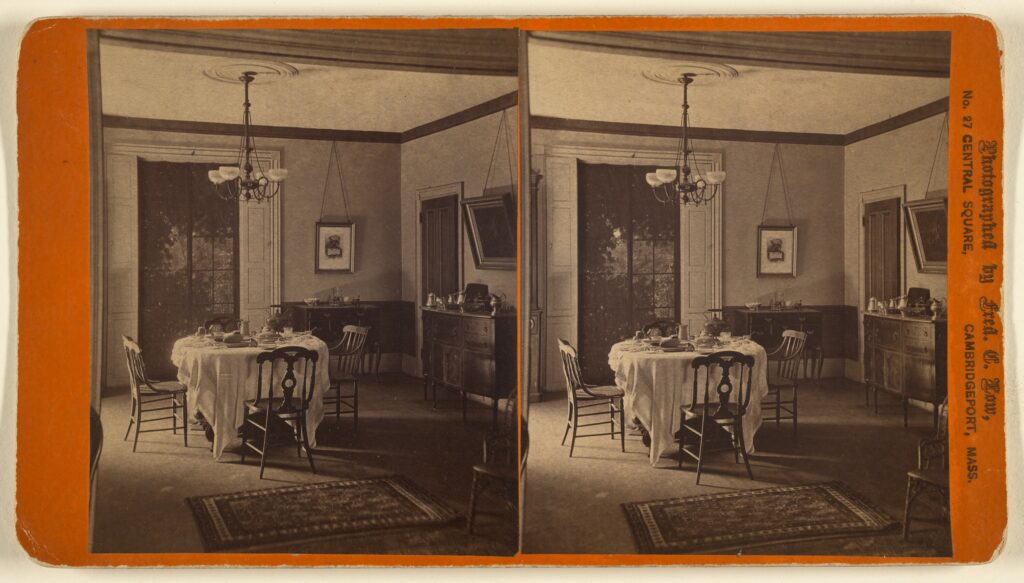
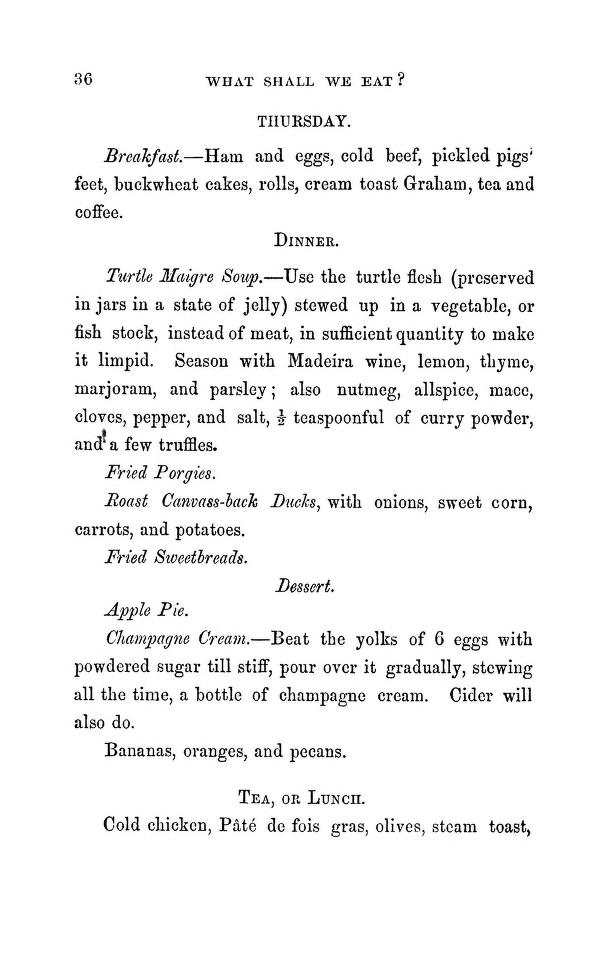
There seems to have been a late-Victorian fad for highly prescriptive housekeeping manuals that promised a meal plan for “every day of the year” — supposedly in order to eliminate the need for planning oneself. A maximum of efficiency at the most basic level. One of the earlier examples of these books, 1868’s What Shall We Eat? A Manual for Housekeepers, opens its preface with its intention to “suggest to ladies, without the trouble of thinking, what is seasonable for the table, each day in the week, and how it shall be cooked.” (This preface includes another, more exciting preview of the book’s contents: “A collection of Pickles and Sauces of rare merit form a desirable addition at the end.” Oho!) The inference being, it appears, that without the burden of having to think about food, these ladies will be free to follow other pursuits. What Shall We Eat? includes menus that suggest that, in fact, rather a lot of thought will have to be devoted to the completion of these meals, if not imagination.
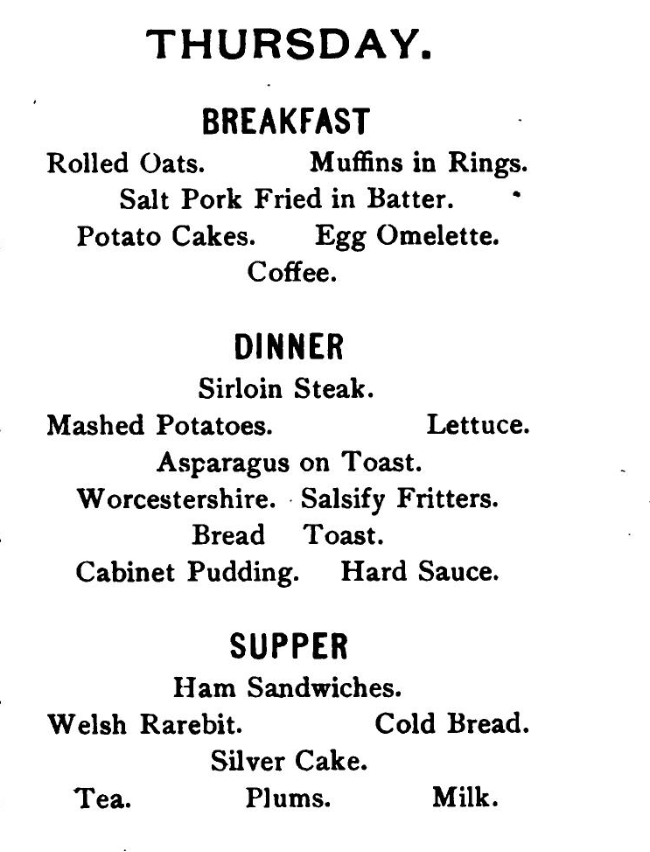
An 1893 booklet of almost the same title, What Shall We Have to Eat? The Question Answered, is slightly more forthcoming in its pitch: “By setting down each day what was served on my own table,” its author, Mrs. Clarence I. Burr, begins, “the thought occurred to me, ‘Why couldn’t I help to a certain extent all my sister housekeepers?” Mrs. Burr’s bills of fare seem to be some of the more practical that appear in this set, and also may be relatively appetizing to a 21st-century meal planner sick to death of “the trouble of thinking.” Mrs. Burr is also concerned with eliminating waste as much as possible — she claims that “a great many dainty and appetizing dishes appear in my menu which at first glance would impress one as both unnecessary and extravagant,” but fear not! “they are really made out of the left overs which are so often thrown aside or left to spoil.” It still seems like a bit much, though — you can hardly be expected to sit down ready for pork steak, mashed potatoes, turnips, and custard pie for dinner (lunch), having only just finished your breakfast of wheat germ mush, sirloin steak, and french fried potatoes. Maybe it’s all in the portion sizes.
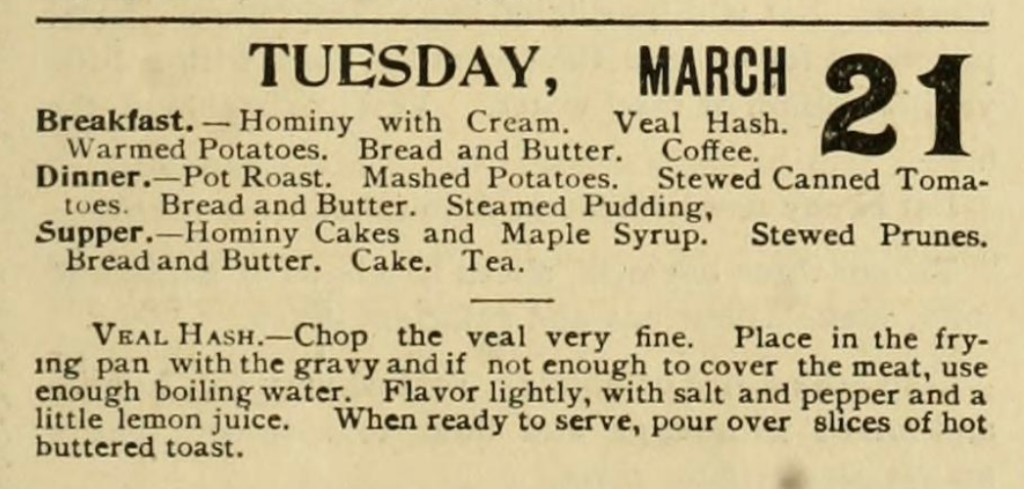
The What Shall We [Have to] Eat[s] of the world are one variety of prescriptive meal-plannery, occupying nearly opposite ends of the period we’re looking at here; the less-personal, far less scrutable, more queasying type is that of 1884’s Three Meals a Day and 1892’s A Bill of Fare for Every Day in the Year. With as little explanation as possible, these pamphlets hurl menus at you with dishes you should be expected to know, and can’t possibly. A Bill of Fare is more utilitarian — if a little daunting at 6:30 AM, a breakfast of oatmeal with cream, scrambled eggs, and hot buttered toast isn’t shocking.
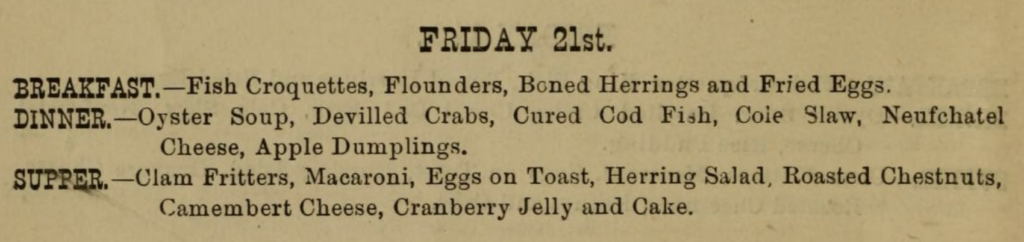
However, if Three Meals a Day was not sponsored by a fish company, something is deeply wrong with the author’s sensibilities. When your workday morning meal consists of “Blue Fish, Veal Cutlets, Sausage, Ham and Eggs” or “Fish Croquettes, King Fish, Boned Herrings and Fried Eggs” only to finish your day with “Meat Croquettes, White Sausage, Calf’s Feet, Sardines, Potato Salad, Emmenthal Cheese, Prunes and Cake” or “Clam Fritters, Macaroni, Eggs on Toast, Herring Salad, Neufchatel Cheese, Apricot Marmalade and Cake,” you tend to do less working than you do recovering.
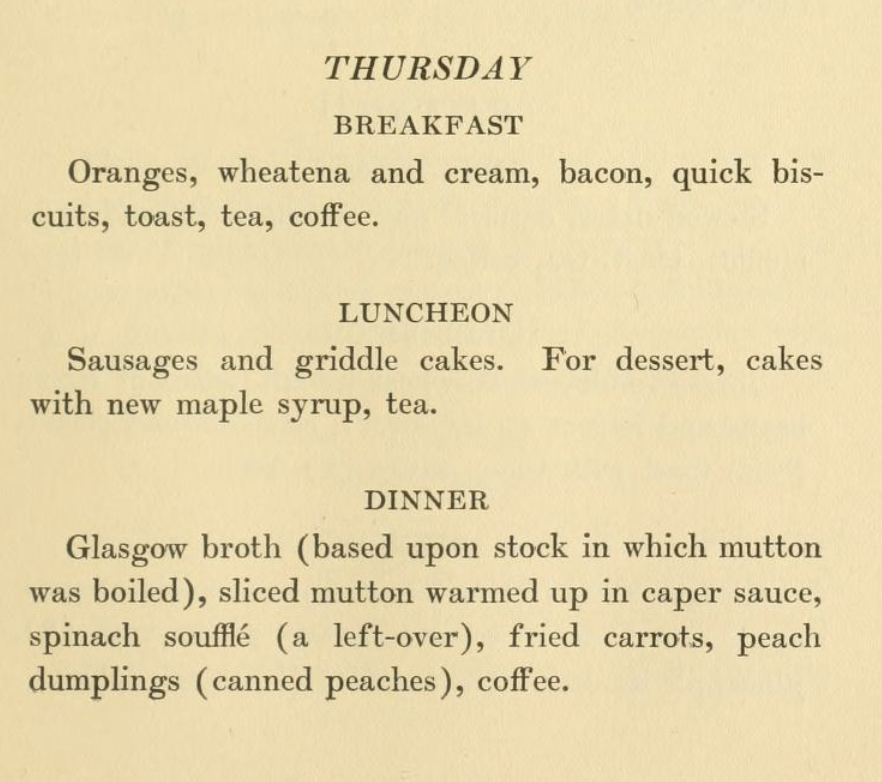
Once we crack through into the twentieth century, the books become slightly less prescriptive and slightly more human. The Helping Hand Cook Book (with a menu for every day in the year) (1912) includes leftovers in nearly every plan, often making up more than half the menu. This, for the first time, is a book targeted directly at “the Mighty Middle Class of American communities,” with the express supposition that “a large percentage of them will attain (I do not say “rise!”) unto wealth.” The Helping Hand most closely (thus far) resembles a modern cookbook — after its week-by-week outline of precisely what to eat in order to do food correctly, there is a list of recipes — you, the terrified housekeeper dreading the notion of thinking, are no longer expected to know each dish by heart.
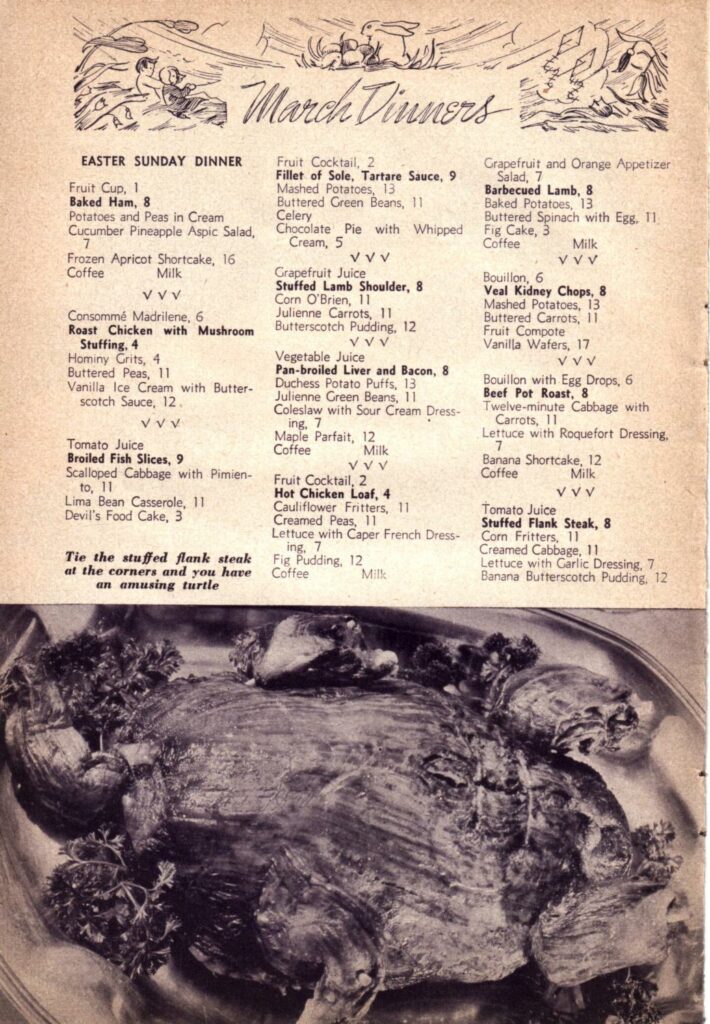
At least one more was published in 1941: Menus for Every Day of the Year (a lie!! Most months only include about 25 meals! Do you expect me to go to a restaurant or a friend’s house, Culinary Arts Institute?!), which heavily emphasizes the demands of health and thrift on meal planning — something that the author’s forerunners may not have had so much on their minds. I am sure that you can still find plenty of this kind of prescriptive meal planning to take you through every year of your life without the burden of thinking about food apart from the moments in which you shop for, cook, and eat it — for plenty of people it is probably extremely useful, and very appealing to cut out a whole phase of this aspect of keeping ourselves alive. If nothing else, the creativity of just being able to list about four thousand dishes — let alone being able to confidently cook them — is a feat that deserves an impressed mutter and a swift exit from the dining room.

All cookbooks available on archive.org.
Leave a Reply